Best Neighborhoods in Alicante for Expats - 2026 Guide
From the buzzing old town to the laid-back beach suburbs - a neighborhood-by-neighborhood breakdown for expats deciding where to live.
Choosing Where to Live on the Costa Blanca
Where you choose to base yourself on the Costa Blanca will define your day-to-day experience more than almost any other decision. The region covers 200 kilometres of coastline and spans everything from dense, walkable city neighbourhoods to quiet mountain-backed villages. We've lived here long enough to give you the honest version - the pros and the cons, the rent ranges that actually reflect the market in 2026, and who each area tends to suit.
Alicante Centro and Casco Antiguo
For a first move to the Costa Blanca, there's a strong argument that Alicante Centro is the right choice. It's a proper Spanish city - not a resort town - with a genuine year-round population, real neighbourhood life, and all the infrastructure you need: hospitals, government offices, good supermarkets, and a lively food and culture scene.
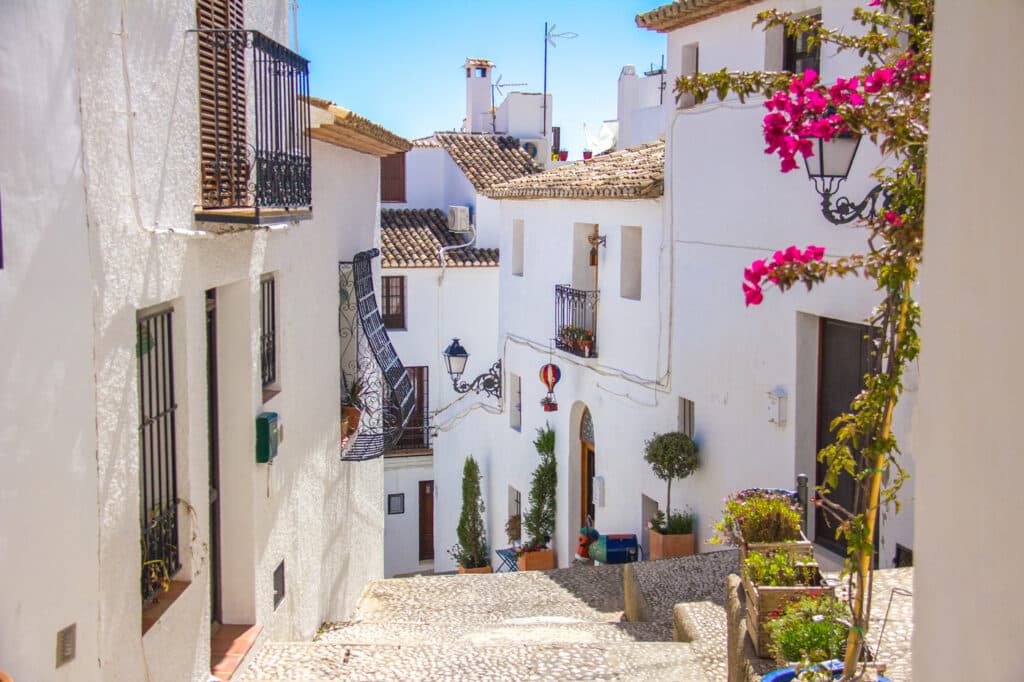
The Casco Antiguo (old town) climbs the slopes below the Castillo de Santa Bárbara. Narrow streets, whitewashed buildings, and tapas bars that have been open since before you were born. It's atmospheric and beautiful, but apartments here tend to be older, sometimes without lifts, and warm in summer because the narrow streets trap heat. Excellent for people who prioritise character and location over modern comforts.
The wider Centro and Ensanche districts are more practical: wider streets, better-maintained buildings, easier parking, and a 10-minute walk to the beach at El Postiguet. This is where most young professionals, digital nomads, and recently arrived expats gravitate.
- 1-bed apartment: €600–€900/month
- 2-bed apartment: €900–€1,300/month
- Best for: Young professionals, digital nomads, first-year expats, people who want city life
- Cons: Noise (especially on weekends), older building stock, summer heat in the old town
Playa San Juan
If the city centre is Alicante's brain, Playa San Juan is where it comes to relax. This residential beach suburb sits six kilometres north of Centro, connected by the TRAM line that runs every 20 minutes. The beach itself - Playa de San Juan - is wide, well-maintained, and significantly less crowded than El Postiguet in the city.
Playa San Juan is popular with expat families and longer-term residents who want beach access without sacrificing convenience. The apartment stock is predominantly modern - built from the 1990s onwards - which means better insulation, fitted kitchens, and air conditioning already installed. The strip along the beach (Avenida de Niza, Avenida de la Costa Blanca) has a good selection of restaurants, cafés, and everyday shops.
- 1-bed apartment: €800–€1,200/month
- 2-bed apartment: €1,100–€1,600/month
- Best for: Families, couples wanting beach lifestyle, longer-stay expats
- Cons: Less "city" feel, quieter in winter, slightly higher rents than Centro
El Campello
Fifteen minutes north of Alicante on the TRAM, El Campello is one of the most underrated bases on the Costa Blanca. It's a genuine working-class Spanish fishing town that hasn't been entirely overrun by tourism - you'll hear Spanish spoken in the bars, there are still fishing boats going out in the morning, and the Thursday market on the seafront is a proper local institution.
El Campello offers significantly better value than Alicante Centro or Playa San Juan, and the quality of life is high: a lovely beach, a good selection of restaurants, and a pace of life that feels genuinely relaxed. The TRAM connection means you're not isolated - Alicante Centro is 20 minutes away.
- 2-bed apartment: €750–€1,050/month
- Best for: Couples, those wanting more space, people who prefer a smaller-town feel
- Cons: Smaller social scene, more limited shopping, car useful for wider exploration
Benidorm: An Honest Assessment
We know what you're thinking. But hear us out. Benidorm is not the place it's caricatured as in British tabloids. Yes, there's a tourist strip with karaoke bars and full-English breakfast menus. There's also a genuinely beautiful old town on a headland between two spectacular beaches, one of the best healthcare networks on the Costa Blanca (proximity to Hospital de La Villajoyosa and several excellent private clinics), and a massive permanent international community - British, German, Scandinavian, and others - who have been here for decades.
The permanent population of Benidorm is around 75,000 - it's a proper city, not just a resort. Rents are meaningfully lower than Alicante, the weather is marginally better (it sits in a sheltered bay), and the food scene in the old town is genuinely excellent.
- 2-bed apartment: €600–€900/month
- Best for: Retirees, those prioritising budget, people with health considerations, older British and Scandinavian expats
- Cons: The tourist zone is exactly as described; limited Spanish cultural scene by comparison with Alicante
Altea: Beauty with Trade-offs
Altea is, objectively, one of the most beautiful towns on the Costa Blanca. The white-domed church on the hill above the old town, the cobbled streets, the artists' studios - it's the postcard version of Mediterranean Spain. It's also home to a small but active international arts community and a good stretch of pebble and sand beach.
The trade-off is that the food and nightlife scene is more limited than Alicante. There are excellent restaurants - but fewer of them. It's a 45-minute drive to Alicante (no TRAM connection) and a 20-minute drive to Benidorm. If your social life centres on the community you build locally rather than city amenities, Altea is wonderful. If you need the stimulation of a city, you'll find it remote after a few months.
- Best for: Retirees, artists, creatives, those who strongly prioritise natural beauty and a quiet pace
- Cons: Limited restaurant and nightlife variety, car essential, more isolated
Jávea and Dénia: Northern Costa Blanca
The northern end of the Costa Blanca - Jávea (Xàbia) and Dénia - is beautiful in a different way from the southern end: greener, more mountainous, with the distinctive profile of the Montgó massif behind the coast. The expat community here skews British, German, and Scandinavian, and has been established for several decades.
Property prices and rents are higher here than further south. Jávea in particular has become quite expensive relative to the rest of the region. Both towns are genuinely lovely and have good infrastructure, but they're more car-dependent than anywhere to the south. Alicante airport is 80–90 kilometres away, which matters when you're catching early flights.
- Best for: Those wanting a quieter life in beautiful surroundings, families, people who work entirely remotely with no need for city access
- Cons: Car-dependent, distance from Alicante, higher rents, can feel isolated in winter
Torrevieja: Value and Community
South of Alicante, Torrevieja is the most affordable significant town on the Costa Blanca and has one of the largest proportional expat populations in Spain - estimates put the British and Scandinavian communities alone at 30–40% of the permanent population. If you want to arrive in a place where it's easy to meet other English speakers quickly, Torrevieja delivers.
The honest note: Torrevieja can feel like an expat bubble. Spanish culture is present but doesn't dominate in the same way it does in Alicante Centro or El Campello. The surrounding salt lakes are genuinely beautiful and ecologically unique. Healthcare infrastructure is reasonable. Rents are very low.
- 2-bed apartment: €550–€800/month
- Best for: Budget-conscious retirees, those who want a ready-made English-speaking community, people from the UK or Scandinavia specifically
- Cons: Feels less "Spanish", limited cultural scene, slightly further from Alicante airport
Our Recommendation
If you're arriving in the region for the first time and aren't sure where you'll settle, spend your first three to six months in Alicante Centro. You'll have easy access to all the bureaucracy you need to sort (NIE, Padrón, bank accounts), a rich social and cultural scene, good transport links, and the freedom to explore the rest of the coast on weekends before committing to a longer-term rental elsewhere. Many people who plan to "eventually move somewhere quieter" find that after a year in Centro, they're in no hurry to leave.